
Maya Date
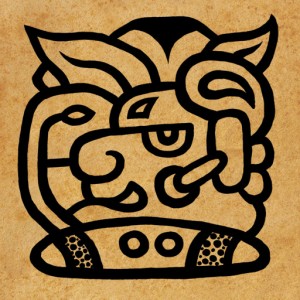
I’ve always found the Mayan writing system to be beautiful and fascinating. They wrote with rich, complicated glyphs that were beautiful, evocative, and often witty. Much of the historical record we have of this writing comes in the form of stone carvings. Of course, carving something in stone is both difficult and time-consuming, so these carvers took lots of design liberties during the process, infusing their work with their own personal style.
As a result, there’s no single, fixed set of symbols, or glyphs, that make up Mayan. Rather, there are lots of different sets of glyphs. This is very much like our own Roman alphabet, which admits thousands of very different typefaces, yet the letters are almost always still recognizable as long as a few key shape elements are preserved.
I wanted to learn to write iPhone apps, and I thought it would be fun to make a program that showed the date in Mayan. I spent many happy afternoons at the Seattle and University of Washington libraries, poring over old books and documents about the Mayan calendar system. They actually had three different calendars, each of different lengths, all running simultaneously but independently. The whole thing is complicated but very cool. There are many details that are hotly debated about these calendars, even including just how they count!
I embraced the Mayan’s freedom with their glyph shapes and drew a new set of original glyphs, strongly informed by the historical record. On the right is a screenshot of the output for a specific date. Using the other screens, you can dial in any date you want (using either our familiar Gregorian calendar, or the Mayan Long Count), and the program will show you the stele for that date, which you can then save or share with others. This stele is structured like the many stone carvings of dates that we’ve found, combining glyphs for months and numbers in a specific arrangement.
There are some controversies over Mayan time-keeping. In each case, I either chose the opinion most popular among the experts, or I let the user make their own choices. I called it Maya Date, and released it on the iTunes App Store. I don’t know much about marketing, so I posted a note to a couple of social media sites and declared my marketing campaign complete. The program was really mostly for fun, anyway, I figured it would sell maybe a dozen copies over its lifetime. To my surprise, about a thousand people have purchased it!

Around the time I wrote this app, the Mayan calendar was going to click over in one of the big counts (like going from 9,999 to 10,000). Someone completely misinterpreted this and claimed it was “the end of the Mayan calendar,” which they then imagined also prophesied natural disasters and worse. This caught the popular imagination, and all kinds of silliness followed, even including several paperback books about just how the Mayans predicted the end of the world, and, well, whatever else the author chose to make up. I tried to set the record straight a little bit, and wrote a description of the Mayan calendar for the app. I’ve kept that information available here. If you’re curious about the app, you can also see screenshots of the running app, and read some information on it, from here.
A fun further development from this is that my original Mayan glyphs have become popular, particularly with museums. In 2010 my glyphs were part of the “Time Pillars” exhibition at the Tallinn City Museum, Estonia. They were used in an online exhibition in 2012 by the The Smithsonian National Museum of the American Indian. In 2013, they were featured in The Denver Museum of Nature & Science. I am, of course, honored and delighted to contribute to these wonderful institutions of history and knowledge.